
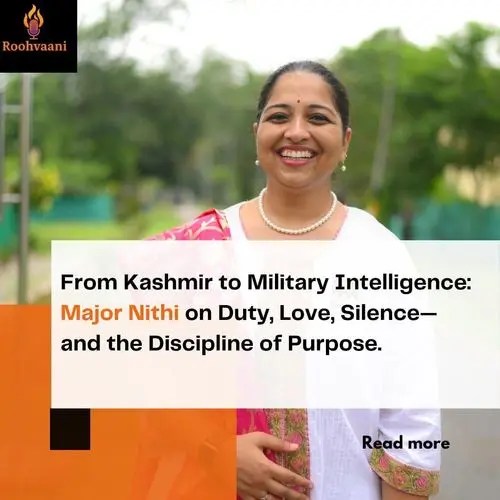
“Every living thing has a purpose of its presence.”
That belief has guided Major Nithi through conflict zones, intelligence operations, separation, and silence—and into a life devoted to civic and behavioural intelligence.
A former Indian Military Intelligence Officer, practitioner of civic and behavioural intelligence, narrative analyst, and TEDx speaker, her journey into uniform did not begin with ambition alone; it began with memory.
In a conversation with Roohvaani, Major Nithi decodes some of the secrets of her life that had remained untouched.
The Valley Where Her Story Began
“I visited my father very regularly when he was in the Valley. I have first-hand experience of both the warmth of the people and the chill of uncertainty in such a tense environment. I still remember how, under heavy security, we had to travel to Lal Chowk, and how, on one occasion, we escaped a blast near Nishat Bagh. I witnessed the sombre tone of villagers on seeing Army vehicles or knowing we were from the Army.
“But the most vivid moment that made me decide to be part of the Army—not just as a family member, but as a soldier myself—was a particular interaction with a captured terrorist. It was during a visit by the brigade commander and his wife to captured terrorists. Such interactions were common then, seen as gestures to encourage rehabilitation into mainstream society. I am talking about 1995–96.
“During this interaction, a 14-year-old Pakistani captive was kindly asked by the first lady about his reasons for apprehension. He replied that he had blown up an officer bus and, with pride, added, ‘Inshallah, if I get more chances, I will do it again.’ The 10–11-year-old me perceived it very differently. It was not hate; it felt profoundly like a call of duty.”
Rejected Twice. Clear on Purpose.
Asked about being rejected twice before clearing on her third attempt and what kept her going, she answers:
“The purpose. By the time the third attempt came, I had already appeared for my UPSC exam and had two job offers in hand. My mother asked what I intended to do next, and I vividly remember replying that my purpose was to serve my country, and I was ready to explore every path possible. I think this deeper understanding made me perform with ease in my third attempt.”
The Haircut That Set Her Free
Asked about the first day of training, when her hair was cut and a new life began, and what part of the old Nithi she quietly left behind, she recalls:
“The one who was susceptible to outcomes. Although my journey up to the three attempts had already battle-hardened me—and not forgetting three years of NCC in college—when I was getting my haircut, I still remember the thought in my mind: ‘Nithi, you’re now free! Free to perform your responsibilities towards your country without any restrictions or worry of consequences. You have got what you dreamt of. It’s now time to live that dream!’”
Intelligence, Humility, and the Ego Left Behind
Asked about life as an Intelligence Officer and what it took from her as a woman and as a human being, she reflects:
“The beauty is, it only gave me more—as a woman and as a human being. Those ten years gave me the highest sense of purpose, which I could have hardly imagined, especially in a woman’s constitution. Interestingly, I didn’t feel the need to prove my femininity, which is generally assumed from outside. My professionalism always took precedence, and credit goes to my seniors and mentors who saw the soldier in me—not my gender.
“I would like to share an experience here. Our branch wears the uniform the least. The reason is beautifully revealed in this anecdote. One day, my commanding officer asked me, ‘Nithi, do you know why we don’t wear the uniform?’ I gave all stereotypical replies—camouflage, adapting to the environment, etc.—and he said, ‘It’s because when you hang the uniform aside, you’re keeping your ego and pride aside. This tradecraft needs utmost humility. The informant is a god; you can’t carry pride and ego to get information from him.’”
Love Without Survival Mode
On how love survives when duty often kept her and her husband apart, she shares:
“I guess love survives between us through this higher dimension. I am going to share something I haven’t done so far. It’s been 13 years of togetherness, and we don’t have kids. Amidst societal pressures, we still share this beautiful communion because of our higher love toward our nation, the divine, and our society. Love never needed to survive between us. Love is there.”
Breaking the Ceiling Without Feeling the Weight
Asked about being the first woman officer from Chhattisgarh to enter through the CDSE route and whether she felt added pressure, she says:
“Not at all! In fact, I saw the immense opportunity it opened for the future of Chhattisgarh. In NCC, I had friends from remote parts of the state who, despite being extremely competent, had to submit to conventional social responsibilities. I am grateful I could break that ceiling, because these strong women constantly supported me.”
The Stories That Stay Silent
On living with stories that can never be shared, even with those closest to her, she admits:
“It’s difficult, but that is what soldiering is all about. When I observe conversations around me—some coming from experiences, some from theoretical frameworks—I choose to stay with the pledge of non-negotiable confidentiality. I know it becomes difficult in my present field of mentoring to deliver without anecdotes; that’s where reading helps me give harmless examples. To be honest, it gives a different intellectual kick!”
Keeping Nithi Alive Beyond the Uniform
Asked who she was without the uniform after retiring as a Major, she explains:
“Fortunately, when I joined the Army, my branch trained me to keep Nithi alive. Of course, there are a few things I am unable to do because of being in a responsible space as a veteran, but I didn’t stop exploring my dimensions—whether it’s yoga, civic intelligence, behavioural intelligence, or even entrepreneurial curiosity. I didn’t see it as de-identification or re-identification.
“The Army is an integral part of my life. It has prepared me to serve the nation and my people irrespective of the uniform. It took me some time to understand the ways of the civil world, but I must tell you—I am enjoying this. It’s not a transition; it’s continuity of the oath of service.”
Leadership, Purpose, and Responsibility
On what truth about courage, sacrifice, or service she wishes every civilian truly understood, she concludes:
“Before I answer that, I want to share why I chose to explore this dimension of leadership, mentoring, civic intelligence, and behavioural leadership. Commonly, leadership concepts talk about inculcating qualities through superficial techniques—personality development, communication, etc. My argument has always been this: human personalities are as fluid as our behaviours, and our behaviours are as rigid or fluid as our life experiences. So why not start with that? That’s where civic intelligence and behavioural leadership step in.
“Every individual should understand their purpose on the planet. Every living thing has a purpose of its presence. My wish is that everyone understood their purpose and lived by it. Stop taking entitlement, and start living responsibly—this life is a gift of the divine.”
Jai Hind

Leave a comment