
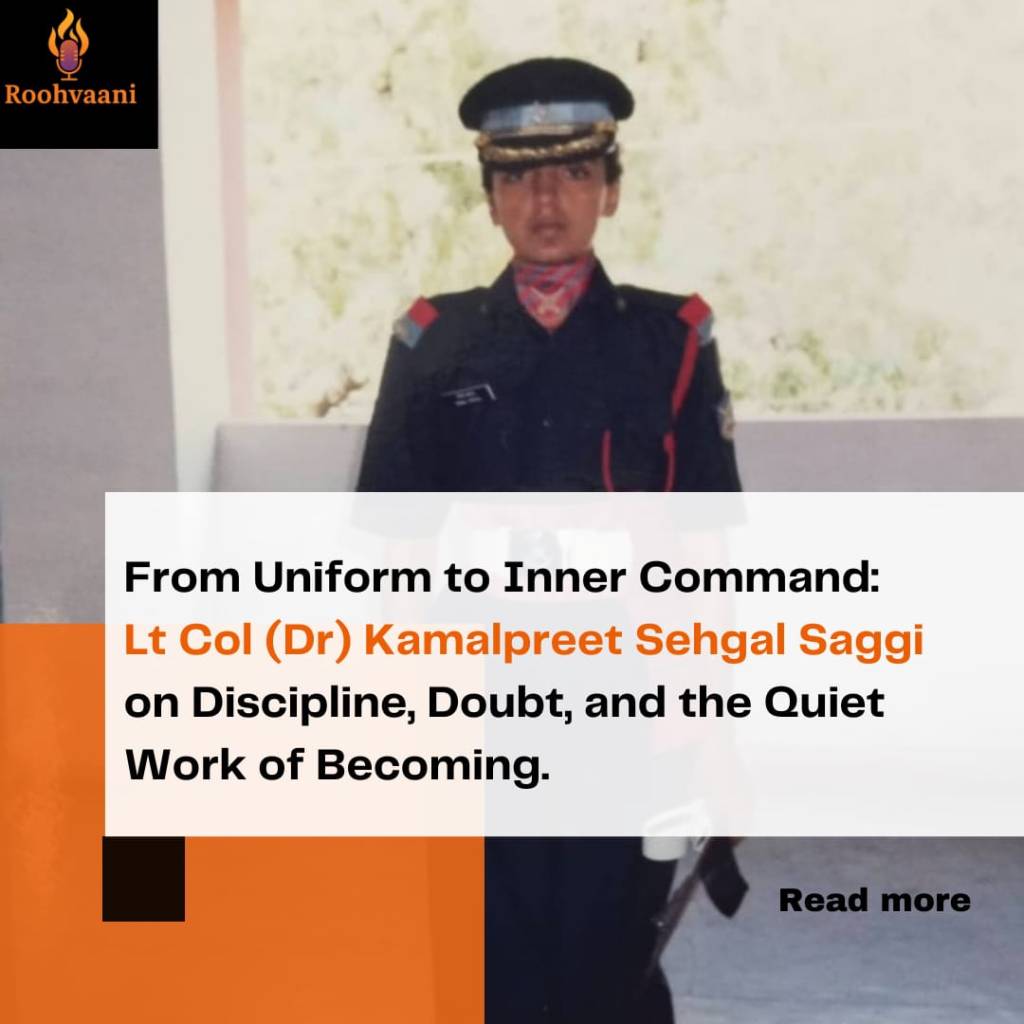
“A Person can retire, but the mindset is permanent.”
For Lt Col (Dr) Kamalpreet Sehgal Saggi, those words are a lens through which she navigates life long after the uniform has come off. A former Army officer, ex-SSB psychologist, and behavioral guide, Kamalpreet’s life has been less about transitions and more about internal command—an ability to move with clarity and integrity in every circumstance. In conversation with Roohvaani, she reveals the disciplines that stayed and the choices that continue to shape who she is.
When you look back at the years in uniform, beyond ranks and roles, how did the Army change you as a person—in ways that still show up in your everyday life?
When I look back, the Army didn’t just give me a uniform or a rank; it fundamentally recalibrated how I engage with the world. Today, difficult conversations don’t deter me. Demanding work doesn’t deplete me. Setbacks don’t destabilize me. I’ve internalized that excellence isn’t built in comfort zones. Military effectiveness depends on discipline, structure, and hierarchy, but it ultimately exists to serve people and the mission.
I learned to hold both: rigor without rigidity, standards without cruelty.
In practice, this means I can enforce accountability while preserving dignity, demand excellence without diminishing individuals, and lead decisively without dominating the voices around me. The Army also instilled a strategic sense of time. I’ve witnessed firsthand that endurance compounds quietly while “flash” burns out quickly. That long-term perspective now governs every domain—how I develop myself professionally, how I guide my child through setbacks, and how I mentor emerging leaders. It allows me to distinguish between temporary discomfort and permanent damage, between short-term wins and sustainable success.
Twenty-two years in uniform didn’t just teach me skills; it forged a lens through which I interpret challenges, gauge character, and contribute value. The rank is retired. The mindset is permanent. And that, perhaps, is the deepest gift of military service—not what you learn to do, but who you learn to become.
You have held space for so many aspirants under pressure. While guiding them, what truth about fear, failure, or self-belief quietly revealed itself to you—something no textbook could ever teach?
I learned that failure is rarely the breaking point; anticipated shame is. The moment an aspirant ties their identity to an outcome—equating selection with worth—their thinking narrows, spontaneity collapses, and performance deteriorates. The mind shifts from problem-solving to self-protection.
The deeper truth about self-belief is uncomfortable: confidence doesn’t come from convincing yourself you’ll succeed; it comes from knowing you’ll survive even if you don’t. Those who succeed are not the ones without fear; they are the ones who have made peace with imperfection. They speak, act, and decide despite the possibility of appearing ordinary or stumbling publicly. That psychological freedom—“I am allowed to be human here”—unlocks clarity, authentic leadership, and true presence.
Guiding aspirants taught me this: when fear is acknowledged without drama, failure loses its sting. When failure loses its sting, self-belief stops being fragile and becomes functional. All have potential; they simply need direction and a slight push, provided they have the intent. That lesson came from watching human beings meet themselves under pressure—and either shrink from the encounter or rise through it. What I carry forward isn’t just strategy; it’s the conviction that resilience is not about being unbreakable—it’s about being unashamed of breaking. Believe me, that is the true sense of being human as well.
Moving from the discipline of the Army to the openness of the public and glamour space is not easy. What emotions did you struggle with during this transition, and what helped you stay grounded when everything around you changed?
The hardest part of that transition was not learning something new—it was unlearning who I was allowed to be. In uniform, identity is clean, purpose is external, standards are clear, and validation is institutional. You know where you stand every day. But when I stepped into the public and glamour space, that certainty dissolved. Perception mattered more than performance, noise replaced silence, and applause arrived along with opinion.
The first emotion I struggled with was discomfort with visibility. In the Army, attention is functional—tied to task, mission, and outcome. You don’t strive for attention; you simply function, working because your inner compass points you there, not because eyes are watching. Outside the uniform, attention felt emotional, aesthetic, and sometimes intrusive. Being seen for how you look or speak—rather than what you deliver—felt unstable. Reconciling these two operating systems was disorienting, as the civilian world often runs on visibility, which may or may not correlate with the quality of your work.
There was also inner resistance—a quiet voice asking, “Does this dilute who I am?” That tension between discipline and display, depth and dazzle, was real. Glamour can feel hollow when your nervous system is trained for meaning, not applause. What kept me grounded was one anchor: internal command. Life after the uniform demanded that I issue orders under constraint, returning daily to non-negotiables—physical discipline, mental order, and ethical clarity. These became my invisible uniform, allowing me to separate identity from environment. Platforms, audiences, and roles shift; core values do not.
People see strength, confidence, and achievements. But was there a moment when you felt unsure of yourself—a moment you rarely speak about?
The decision to leave Amazon—to walk away from the comfort of an approximately ₹1 crore package—was one of those moments. It came with questions I wasn’t prepared for. Uncertainty stopped being theoretical and became real, personal, and constant. What I felt wasn’t weakness, but confusion—a chaos that signaled an old framework no longer fit.
Financial support mattered because I feared instability—the kind that creeps into your thoughts at night and changes how you make choices for yourself, your children, and your aging parents. Introspecting during this time honed me. Walking away from so-called financial success meant sitting alone with questions no one else could see. People expect you to doubt yourself when things go wrong, not when things are going well. Confidence then wasn’t loud; it was quiet, steady, and almost invisible.
Freedom isn’t free, and the price is living without guarantees. But while stillness has a place, paralysis does not. I chose action. I learned to separate emotions from decisions by treating them as a feedback system, stripped away comfort mistaken for necessity, and kept doing the work even when motivation dropped. Consistency outlives inspiration. What kept me standing wasn’t certainty about what came next, but trust in who I’d already become.
You understand the human mind deeply and help others heal and grow. What has been your own hardest inner battle—one you had to fight silently, without reassurance or guidance?
The hardest inner battle I fought was learning to hold myself without being held. I realized that you always have a choice, and you become what you choose. I chose to maintain the warrior mindset always, even when my entire being wished to relax under the guise of excuses or comfort.
For most of my life, there were structures—the Army, institutions, roles, and expectations. Even when things were difficult, there was a framework that told you who you were supposed to be. In institutions like the military, we are handheld, guided, and groomed. That is not the situation outside. When that framework was gone, the silent battle became staying internally aligned when no one was validating the path.
There was a phase where I was guiding others and appearing composed while internally recalibrating everything: identity, direction, and worth. There was no mentor above me, no reassurance from the outside, and no precedent that said, “Yes, this is the correct way to evolve.” There were just quiet days where doubt showed up unannounced and stayed longer than comfort. My mistakes were entirely mine, and I gracefully took them in stride. I learned the hard way about the politics of the office and the “other side” of human nature—things I didn’t want to believe existed, but do.
Through your work, you meet many young minds searching for strength. What do you feel they misunderstand most about resilience — something life taught you the hard way?
What most young minds misunderstand about resilience is that they think it is about enduring pain loudly; in reality, it is about functioning quietly despite it.Resilience is far more ordinary, boring, and demanding than people realize. It is waking up on days when nothing feels certain and still keeping your standards intact.
Another deep misunderstanding is that resilience means never feeling affected. The resilient feel everything—disappointment, betrayal, fatigue—but they don’t allow those feelings to rewrite their values. Resilience is not built during a crisis but is revealed by what you practiced before the crisis. Resilience is not heroic; it is consistent.
Your life has been about service in different forms — first to the nation, now to individuals. At what point did service stop being a duty and start becoming a calling for you?
Well, service stopped being a duty and became a calling when the hunger to “be something” quietly waned. In the first few months, there was confusion, with service intertwined with performance—doing well, meeting standards, and justifying my place. That phase was necessary for competence, but it was still driven by validation.
The shift happened when the need to prove dissolved. I noticed it when outcomes stopped feeding my ego and started feeding my sense of responsibility. In uniform, service is assigned; outside it, service is chosen. When you choose it without the hunger for recognition, it becomes cleaner, quieter, and more enduring.
The calling deepened when I started working with individuals—aspirants, veterans, and people rebuilding themselves after a loss of structure. There was no rank compelling me and no institution backing me, yet I stayed. Not because I had to, but because walking away felt internally dishonest. I became driven by my inner calling, and there was nothing stopping it. Service became less about demonstrating strength and more about stewarding it.
If someone is standing where you once stood — confused, uncertain, and afraid to choose — what would you tell them today, from your heart?
Confusion is not weakness but a chaos that, when challenged and looked in the eye, signals that an old framework no longer fits. Fear appears when a choice has real consequences, not because of incapacity, so don’t rush to escape discomfort by grabbing quick relief. Choose action—stillness has a place, paralysis does not. Think logically, treat emotions as feedback, process them, learn, and act anyway.
Be ruthless about priorities versus luxuries, choosing what truly matters—stability, dignity, growth, alignment—and work toward it daily, repetitively, without drama, because consistency outlives inspiration and strength is built on ordinary, resistant days. Talk to yourself deliberately, be firm and fair, and speak only to those who want your stability, letting difficult phases clarify who belongs.
Most importantly, never give up on yourself. Strengthen yourself mentally, physically, ethically. Take the next aligned step with discipline. Choose action, choose integrity, and stay loyal to yourself long enough—because you are your safest and best bet.
And finally, beyond every role you are known for, who is Kamalpreet when no one is watching — a part of you the world hasn’t met yet?
Beyond uniforms, titles, and leadership roles, there is a part of me that is deeply observant and private. I listen more than I speak and notice patterns—in people, in silence, and in energy shifts—that never make it to words. That part doesn’t perform; it witnesses.
Strength, for me, is not loud; it is contained. My empathy has deepened because life has tested it; it is an understanding I have earned through continued experience, not borrowed compassion. Even when no one is watching, I am disciplined in small, invisible ways—early mornings, physical training, and deliberate solitude. That private discipline is the source of whatever steadiness others notice publicly.
Finally, there is a deep reverence for silence. Silence is where I recalibrate, forgive, and let go of what the world never needs to know. Some battles don’t require witnesses. Some growth doesn’t need narration. When the world isn’t looking, Kamalpreet is not striving, explaining, or defending; she is Becoming, Doing, Being, Creating, and… at peace.

Leave a comment