
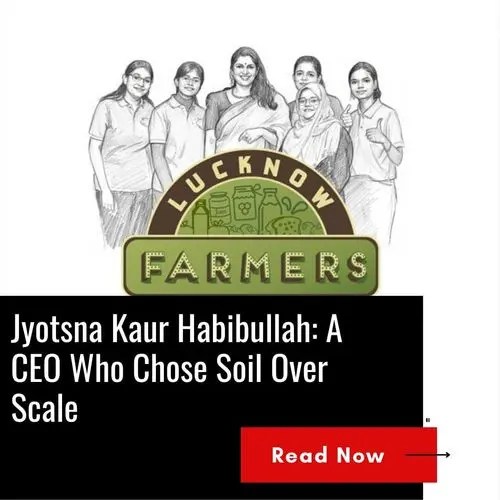
Real empowerment is not a transaction; it is the moment we realizes our heritage is our greatest asset. At Lucknow Farmers Market, we aren’t just selling produce or fashion—we are reclaiming our relationship with the earth, one local harvest and one upcycled thread at a time.
That belief sits at the heart of Jyotsna Kaur Habibullah’s work. CEO of Lucknow Farmers Market (LFM), TEDx speaker, and custodian of a historic estate, her journey into entrepreneurship was shaped not by ambition alone, but by responsibility, circumstance, and an acute awareness of what was quietly being lost.
In a quiet, reflective conversation with Roohvaani, Jyotsna did not speak about scale, valuation, or disruption. She spoke about soil. About the food on her children’s plates. About heritage—not as nostalgia, but as responsibility.
When she moved back to Lucknow 15 years ago to give her children a sense of their roots, the return home came with an unsettling realization. She realized how difficult it was to find healthy, chemical-free food for her own family. She realized that if she was struggling to protect her children’s health from pesticides and artificial agents, then the larger community was facing the same challenge.
What began as a personal concern soon expanded into a larger vision. She saw that “we are custodians of our heritage,” and this realization led her to a defining conclusion: the Habibullah Estate could not remain merely a monument to the past. It had to become a platform for a healthier future. The lightbulb moment came when she looked at the vast talent of local farmers and artisans and saw them being sidelined by mass production, just as traditional, clean ways of eating were being displaced by convenience. Her responsibility, she understood, wasn’t just “preserving walls”; it was “preserving ways of life.” The legacy provided the stage, but the mission became ensuring that heritage remained a living, breathing, and—most importantly—healthy economy for the next generation.
The transition was far from predictable. Managing the estate, Jyotsna explains, is only one part of what she does. Choosing to build Lucknow Farmers Market meant stepping into what she calls the “chaos of creation.” Her biggest fear was whether a mission-driven model could survive in a profit-driven world. She grappled with the internal conflict of moving from a corporate life to a public role as an advocate for sustainability. Yet she chose purpose, guided by the belief that predictability often leads to stagnation, whereas purpose leads to evolution.
At the core of LFM is people—particularly women. For Jyotsna, true empowerment goes far beyond income. She sees it as a two-way mirror. Beyond a paycheck, it is the moment a woman gains the agency to make her own choices and the confidence to lead her community. Working closely with women farmers and artisans transformed her in return. Their resilience in the face of climate shifts and economic hardship stripped away her own hesitations. They taught her that empowerment isn’t a gift you give someone; it’s a fire you help them light within themselves.
Lucknow Farmers Market was born well before “sustainability” became a buzzword. There was no clear roadmap, no mentors, and no precedents. Trust had to be built from the ground up. According to Jyotsna, it was built in the “inches,” not the miles. With farmers and artisans, it meant showing up consistently and proving that their soil and craft were valued as much as their harvest and products. With consumers, it meant radical transparency—using the estate as a space where people could meet the person growing their food. By choosing to be slow and deliberate, LFM built a foundation of trust that modern marketing simply cannot buy.
Resistance was inevitable. The strongest pushback came from social pressure to scale fast and economic skepticism that local could ever compete with global. Personally, there were moments of doubt—moments when Jyotsna wondered if slowness was a weakness. She stayed rooted by returning to the soil—quite literally. Seeing a single farmer’s life improve or a family switch to chemical-free food became constant reminders that grassroots change is quiet, but deep and permanent.
More than a decade into building Lucknow Farmers Market, Jyotsna’s definition of success looks very different from conventional metrics. She defines success by ecosystem health rather than valuation. If the soil is better, the farmer is wealthier in spirit and health, and the consumer is more mindful, that is success. Success also means making crafts relevant to today’s marketplace, ensuring indigenous techniques do not die out, and enabling the next generation to bring design intervention that takes these products global. For her, Lucknow’s recognition as a UNESCO Creative City of Gastronomy stands as proof that local, slow flavors are, in fact, world-class.
Community, she believes, is a living organism. Real change is never top-down; it unfolds through conversations at dinner tables and shared experiences at market stalls. When people come together at the grassroots, they bypass the filters of industry and government, building support systems resilient to external shocks. Real change happens when a community decides to value its own resources and traditions.
Her advocacy for “Eat Local & Seasonal” and “Reduce, Reuse, Recycle” is rooted in daily practice, not slogans. Her advice is simple: start small and stop trying to be perfect. Sustainability, she insists, should not feel like a modern chore, but a return to roots—choosing one local seasonal fruit over an imported one, restyling an old garment instead of buying new fast fashion, slowing down consumption. Her Root to Runway show on 8th February reflects this philosophy, encouraging the next generation to reduce their carbon footprint by slowing down fast fashion. When these actions are seen as mindful consumption rather than a checklist, sustainability becomes an empowering lifestyle rather than a performance.
Looking ahead 10–15 years, Jyotsna hopes Lucknow Farmers Market leaves behind a clear blueprint for informed consumption. She wants the next generation to see that profit and planet are not mutually exclusive, and to recognize that heritage is our greatest asset for innovation. Her hope is that LFM will be remembered as the spark that proved a community-first, ethical economy is not just possible—but the only sustainable way forward.
In a world chasing speed and scale, Jyotsna Kaur Habibullah’s work is a reminder that some of the most enduring revolutions begin by slowing down—and looking back to our roots.
#JyotsnaKaurHabibullah #LucknowFarmersMarket #SoilOverScale
#CommunityFirst #SustainableBusiness #WomenEntrepreneursIndia
#LocalEconomy #EthicalLiving #FarmToTableIndia


Leave a comment