
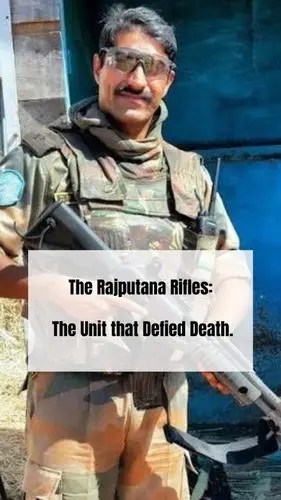
At 19,700 feet on the world’s highest battlefield—where oxygen is scarce, temperatures plunge to –45°C, and every step could be your last—the soldiers of the Rajputana Rifles hold their post. Quietly. Relentlessly. Guided by a war cry that has echoed across centuries: Raja Ram Chandra ki Jai.
Major Samar Pal Singh Toor is one such officer of the 8th Battalion, the Rajputana Rifles—a soldier, Green Beret–trained officer, UN peacekeeper, drone warfare specialist, and TEDx speaker whose career spans the most extreme frontiers of modern conflict.
By any conventional measure, Major Toor’s life defies ordinariness. Yet what truly defines him is not the extremity of his experiences, but the composure with which he has faced them. Across icebound battlefields, civil wars, hospital corridors, and boardrooms, one principle has remained constant: Sewa Paramo Dharma—service is the highest duty.
Born into a family shaped by military tradition, Toor understood early that service is not a profession; it is a way of life. His formative years at Sherwood College, Nainital—an institution renowned for character-building—laid that foundation. Schooling across Noida and Jammu followed, a childhood marked by movement and adaptation, quietly preparing him for a life that would demand both.
He later earned a Bachelor of Business Administration from Maharaja Sayajirao University, Vadodara—a qualification that would later complement his operational leadership. Destiny soon followed. In 2010, he joined the Officers Training Academy, Chennai, and a year later was commissioned into the elite 8th Battalion, the Rajputana Rifles—one of the Indian Army’s most storied infantry regiments.
A Photograph That Shaped a Code of Leadership
During his training days at OTA Chennai, a photograph captured a moment that would later feel prophetic. Behind a young Gentleman Cadet Samar Pal Singh Toor hung the image of Lt Col Yonathan “Yoni” Netanyahu—the Israeli commander who led the legendary 1976 Entebbe hostage rescue and paid for it with his life.
For Major Toor, Netanyahu was never a geopolitical symbol. He represented leadership under impossible odds—moral clarity amid chaos, command tempered by sacrifice. The Entebbe operation shaped a belief that guided him throughout his career: a soldier’s duty transcends borders. It is rooted in protecting lives, regardless of identity.
Siachen: Where Endurance Becomes Discipline
That belief was tested early.
His first major operational posting took him to the Siachen Glacier, the world’s highest battlefield. At nearly 19,700 feet, temperatures plunge to –45°C, oxygen thins, and the environment itself becomes the primary adversary.
At Siachen, survival is not instinctive—it is disciplined. Every movement is deliberate. Every lapse carries consequence. Among soldiers of the Rajputana Rifles, endurance is not celebrated as heroism; it is accepted as duty.
It was here that Major Toor learned a truth that would follow him throughout his life: the most dangerous enemy is not always the one firing at you—it is the moment you choose to stop enduring.
That lesson followed him far beyond the ice.
South Sudan: Holding the Line When Peace Collapsed
In 2013, Major Toor was deployed on a United Nations peacekeeping mission to South Sudan—an assignment intended for stabilisation, but one that rapidly descended into one of the decade’s most violent civil conflicts.
At the height of the crisis, 6,000 to 10,000 armed rebels launched a coordinated assault on a UN logistics base at Malakal. The Indian contingent of 8 Rajputana Rifles was heavily outnumbered. Reinforcements were unavailable, and ammunition ran dangerously low.
The battalion fought till its last bullet and last drop of blood.
For nearly two years, rotation was impossible. The unit protected civilians, fellow peacekeepers, and the UN mandate—often at immense personal cost. Home became an abstraction. Responsibility became absolute.
Inside the Counter-Terror Frontlines of Kashmir
As an officer of the Rajputana Rifles, Major Toor was deeply involved in intelligence gathering, counter-terror operations in Jammu & Kashmir during a period of heightened militant activity.
On 13 September 2018, he was part of Operation Jhajjar Kotli in Reasi district—a high-intensity encounter that continued for several hours. The operation led to the elimination of three hardcore Jaish-e-Mohammed terrorists, though it came at a cost: twelve security personnel, including a Deputy Superintendent of Police, were injured.
Amarnath and Article 370: Command Amid National Turning Points
Major Toor also served at the Amarnath Cave sector for two consecutive years—a deployment marked by exceptional sensitivity and national importance.
During this tenure, he and his battalion played a decisive role in securing the Amarnath Yatra amid sustained terror threats, including the foiling of a plot aimed at disrupting the pilgrimage. The security environment grew especially volatile in the lead-up to 5 August 2019, as the abrogation of Article 370 reshaped the region’s landscape. Amid intelligence warnings of retaliatory strikes designed to trigger chaos, they oversaw the safe evacuation of pilgrims from the cave—an operation that demanded restraint, precision, and unshakeable calm, hallmarks of the Rajputana Rifles ethos.
The Force That Stood Behind the Soldier
Amid the uncertainty of military life, Major Toor found constancy in Renu, the woman who would later become his wife. Fully aware of the risks inherent in a soldier’s calling, he once urged her not to bind her life to such unpredictability.
She refused to leave.
Through prolonged absences, relentless deployments, and the emotional toll of conflict, she remained his anchor—quietly resilient and unwavering in belief.
The Battle No Training Could Prepare Him For
Major Toor retired from active service in October 2021, concluding a distinguished military career. He transitioned into defence collaboration roles, including work with Israel Weapon Industries (IWI), supporting the deployment of advanced weapon systems for the Indian Army.
Then, in 2023, life tested him in a way no battlefield ever had.
What began as a fever escalated with terrifying speed. Within hours, he was placed on life support. During treatment for suspected bio-agent exposure, his heart reportedly stopped for 10 to 12 minutes. He slipped into a coma. The NDM-1 superbug—among the most antibiotic-resistant pathogens known—ravaged his body.
Doctors prepared his family for the worst.
Against all medical probability, Major Toor survived—by the same discipline that had once kept him alive at 19,700 feet.
Recovery was slow and disorienting. It took a month for him to recognise his wife. His military lifetime savings were exhausted in this treatment. With no pension being a short service officer, it took a year for a full health recovery, silence replaced the structure of service.
But he did not stand alone.
His paltan—the soldiers of the Rajputana Rifles—along with his coursemates, family, and friends, closed ranks around him, just as they had in battle. And once again, Major Toor chose purpose over despair.
When Survival Raised Unanswered Questions
The unusual nature of his collapse did not go unnoticed. Indian authorities, including the National Investigation Agency (NIA), reviewed his medical records amid concerns of possible exposure to a biological toxin, including ricin known for its lethality and minimal forensic traceability. No official conclusions have been made public.
The case has since been cited by intelligence experts in broader discussions on hybrid warfare where covert biological tools, psychological profiling, and cyber-surveillance blur the line between attack and accident.
For India’s security establishment, it served as a sobering reminder: modern conflict increasingly hides behind the façade of misfortune.
Redefining Service in the Era of Drone Warfare
Refusing to disengage from national security, Major Toor immersed himself in research on drone warfare and modern combat technologies.
Today, he serves as Director and Chief Growth Officer at Zulu Defence, a Bengaluru-based firm designing weaponised kamikaze drones for the Government of India—systems aligned with the future of asymmetric warfare.
His life, he reflects, has turned “360 degrees.” His purpose has not.
From Malakal to the Silver Screen
Major Toor’s leadership during the South Sudan mission is now being adapted for cinema. A biopic titled Malakal is in development, with John Abraham portraying him. The film chronicles the stand taken by the 8th Battalion, the Rajputana Rifles, when Indian peacekeepers held their ground against overwhelming odds.
A Legacy Defined by Restraint, Not Rhetoric
Major Toor remains restrained in how he defines legacy.
Religion, for him, has always been personal—never political.
“Saving citizens is our only religion,” he has said.
Ultimately, this is not just the story of one officer.
It is the story of the Rajputana Rifles—a regiment whose soldiers endure glaciers, insurgencies, civil wars, and personal battles, yet never lose their moral centre.
For India’s youth, his life offers a powerful lesson: service does not end with a uniform, courage is not confined to combat, and resilience is the most enduring weapon of all. # Major Samar Pal Singh Toor #Rajputana Rifles #Indian Army #Military Leadership #National Security



Leave a comment