
In conversation with Roohvaani, Eva Hanifa, founder of SBN – Sisterhood Business Networking said:
“At my core, I have always been a builder of systems and people, not just projects. I spent over 15 years in multinational organizations working across marketing, partnerships, and community-driven initiatives, where execution discipline and accountability mattered. Personally, I observed how many capable women delayed their own growth because they were prioritizing family, stability, or cultural expectations. That awareness shaped my sensitivity toward women who later in life decide to reclaim their confidence, voice, and economic independence.”
Her journey into women entrepreneurship was not triggered by a single breakthrough moment.
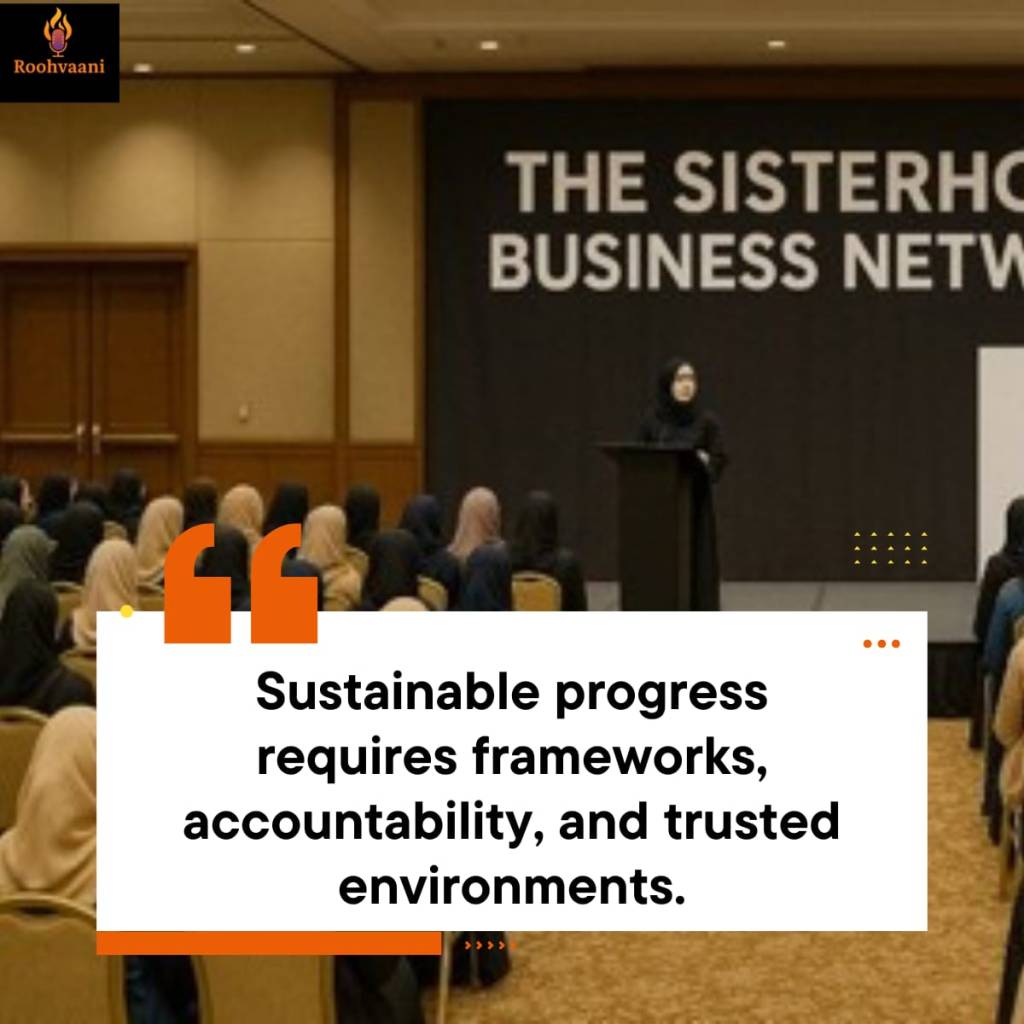
“There was no dramatic moment, it was a gradual realization. I was achieving professional milestones, yet repeatedly encountering women who were intelligent and capable but stuck due to lack of structure, clarity, and support systems. I realized motivation and inspiration do not solve operational and psychological barriers. Sustainable progress requires frameworks, accountability, and trusted environments.”
What she noticed was a recurring pattern.
“I consistently saw women attend workshops, feel energized, then return to confusion, isolation, and inconsistent execution. The problem was not desire or ambition. The problem was lack of systems, decision clarity, and peer accountability. Without structure, motivation decays quickly.”
Professional spaces, she says, often failed to provide what women entrepreneurs truly needed.
“Most professional environments I experienced were transactional and performance-driven. Relationships were often shallow, and learning was fragmented. There was little room for long-term development or psychological safety. I wanted to create a space where growth is paced, trust is prioritized, and progress is measured sustainably rather than emotionally or socially.”
At the center of this challenge lies an invisible burden.
“Cognitive overload. Women often juggle multiple identities; mother, caregiver, operator, strategist, while managing financial pressure and self-doubt. They carry high emotional responsibility but receive limited structural support. This leads to decision fatigue, inconsistent momentum, and self-questioning.”
She recalls one transformation that reflects this reality.
“A mother of two joined SBN while running a small home business and managing household responsibilities. She was exhausted, reactive, and constantly behind. Together we simplified her operations, clarified her priorities, and created realistic weekly structures. Over time, she regained control of her schedule and emotional energy. She later shared that she no longer felt like she was constantly failing, she felt capable again.
That stayed with me because it showed how structure reduces emotional pressure, not just workload.”
As conversations around AI in business grow louder, her approach remains grounded in clarity and simplicity.
“I approach AI the same way I approach any operational system; simplify the objective before introducing the tool. Most women do not struggle with intelligence or capability; they struggle with overload, fear of doing something wrong, and unclear application.
First, we always start with a real business problem, not with technology. For example: reducing admin time, improving content consistency, organizing customer data, or decision support. Once the problem is clear, the tool becomes secondary.
Second, we teach use cases in plain language and real workflows, not features or technical terminology. Women learn faster when they can immediately apply something to their daily operations rather than memorizing software logic.
Third, we normalize experimentation and mistakes inside a psychologically safe environment. Many women hesitate because they fear appearing inexperienced. When learning is framed as testing, iteration, and shared discovery, confidence builds organically.
Fourth, we integrate AI into existing routines rather than adding complexity. If a tool increases cognitive load, it defeats its purpose. Simplicity and repeatability matter more than sophistication.
Finally, we anchor technology as a support system, not a replacement for judgment or human connection. AI should free mental bandwidth so women can focus on strategy, relationships, and leadership — not create dependency or intimidation.”
Leadership, she admits, has required its own internal recalibration.
“Learning emotional boundaries. When you hold space for women dealing with financial stress, family pressure, or identity shifts, it is easy to absorb emotional weight. Sustainable leadership requires clarity of role, boundaries, and personal resilience.”
Ultimately, her vision for women entrepreneurship extends beyond revenue milestones.
“Clarity, confidence in decision-making, and sustainable operating discipline; not just business growth. That they learned how to lead themselves before leading enterprises.”


Leave a comment